


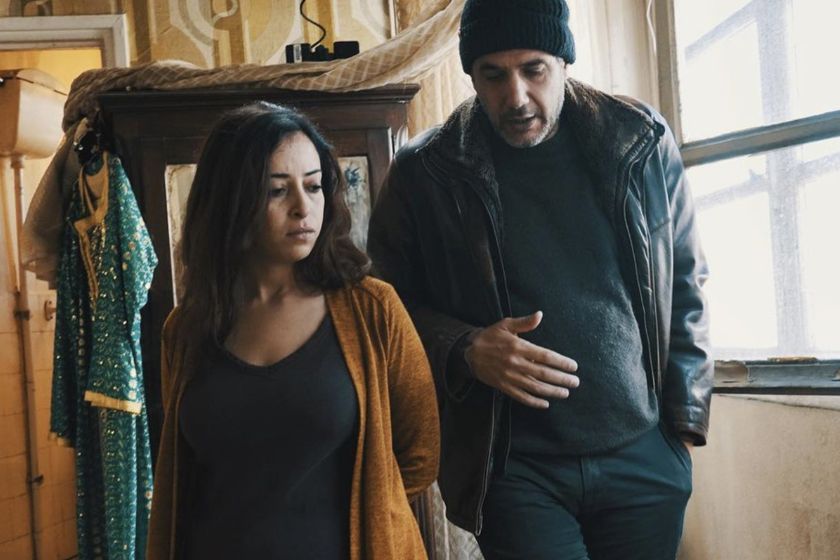
Nabil Ayouch returns to the screen with Everybody Loves Touda, the story of a young woman who dreams of becoming a chikha. The film is part of the official selection of the upcoming Cannes Film Festival, which starts on May 16, 2024. It’s an opportunity for Shoelifer to meet this socially committed filmmaker.
After “Haut et Fort,” dedicated to hip-hop, Nabil Ayouch immerses us in the world of Aïta, through the character of Touda, a single mother who performs every night in the bars of her small provincial town. This popular art form, often marginalized (and endangered), has always elicited admiration as well as contempt, perhaps because we envy the freedom of expression that makes the chikhates feminists ahead of their time. Or maybe it’s because we criticize the (supposed) looseness of their morals. Regardless, in Everybody Loves Touda, Nabil Ayouch pays tribute to these underappreciated poetesses. Here’s the interview.
After hip-hop, Aïta?
You could say that, yes (laughs). Beyond Aïta, it’s above all a meeting with women who have haunted my films for many years now, since Les Chevaux de Dieu (God’s Horses), as well as discussions I had afterwards with other chikhates to prepare for this film. Each time, there was this strong conviction of the fundamental role played by these women within Moroccan society.
Women adored as much as they are despised…
Yes, there’s a certain ambivalence on this subject. They are genuine artists who carry a beautiful heritage, a sung poetry that is Aïta, and at the same time, you can feel that from the mid-20th century onwards, their image changed among the population. This is partially because they had to compromise by going to the city to sing in cabarets and at weddings. Also, conservatism certainly played a role… It’s this ambivalence, this paradox, this status of heroines who are ultimately not well-loved that interested me and that I wanted to address in this film.
According to you, why aren’t they liked?
The relationship between chikhates and society is very ambiguous. They are capable of evoking absolutely phenomenal emotions in the audience, men and women alike. The power of their songs transcends all those who listen to them. I think that the very act of letting oneself be carried away by these songs is something that we resist. And these women are the embodiment of this transformation of the individual that occurs through singing and rhythm as soon as they take the microphone. I also think that this power they have, especially over men, is something that some people find disturbing.
Moreover, being able to liven up various places, including places where there is alcohol and money, is enough to stereotype them and reduce them to something else. These are the cliches that I denounce in this film. We really need to remember who they were and who they still are today.
So, the film tells the story of Touda, who leaves her village to become a chikha.
Yes, it’s the story of a woman in search of emancipation. She lives in her small village and she has dreams. Since she was a child, she has been training in rhythms and taârija to become a chikha. She knows all the aïoutes by heart. She carries this dream within her as a desire for social mobility through her art. She wants to be considered first and foremost as an artist. She has a young son who is hearing impaired and who she wants to offer a better future through education. So, she will use the only tool she has: singing. And she knows that to succeed, she must leave her village and head towards the city of lights, Casablanca.
Read also : INTERVIEW: ASSA D BOUAB, THE ROMANTIC BEAUMARCHAIS OF THE SERIES, FRANKLIN
Nisrine Erradi, who plays Touda, sings and dances in the film. How did she prepare to embody her character?
Nisrine worked tirelessly for a year and a half before filming. She was coached by chikhates, including Khadija El Bidaouia, who passed away during the preparation, and Siham Mesfiouia, a young “purist” chikha who is one of the few of her generation to carry on the tradition of Aïta.
She trained in singing, rhythm, taârija… She practiced moving like them, speaking like them. She did an absolutely phenomenal job to be believable in the role of Touda.
Your film has been selected in the “Cannes Première” category, a first for a Moroccan director…
Yes, but it’s not in competition. “Cannes Première” is a bit of the prestige of the Cannes official selection, where we find established directors like Léos Carax and Emmanuel Courcol.
Your films are sometimes divisive and often debated, even outside of Morocco. Each time, your characters are marginalized by the system: homosexual prostitutes, youth from disadvantaged neighborhoods, etc. Do you find it easier to make these socially conscious films in 2024 in Morocco than it was 10 years ago?
Yes and no. I think Morocco has evolved in many aspects, and at the same time, conservatism is still very present. In fact, it is perhaps more present than ten years ago,but in other forms that often come more from the public. For example, just look at the ongoing reform of the Moudawana, which has sparked strong reactions in conservative camps. As soon as we want to touch on the status of women, polygamy, inheritance, or even the marriage of minors, there is a terrible outcry.
Things are changing, for sure, but there are conservative reflexes that are still very much there. And at the same time, there is this extremely vibrant Moroccan youth, expressing itself in all possible forms, whether through cinema, street arts, song, dance, etc. Society is in motion. And in a way, these two aspects of society are at the heart of public debate. On one hand, there is this desire to open up and move towards modernity, and on the other hand, there is a category of the population that is resistant to change. We live in a somewhat paradoxical, schizophrenic society when it comes to certain subjects.