


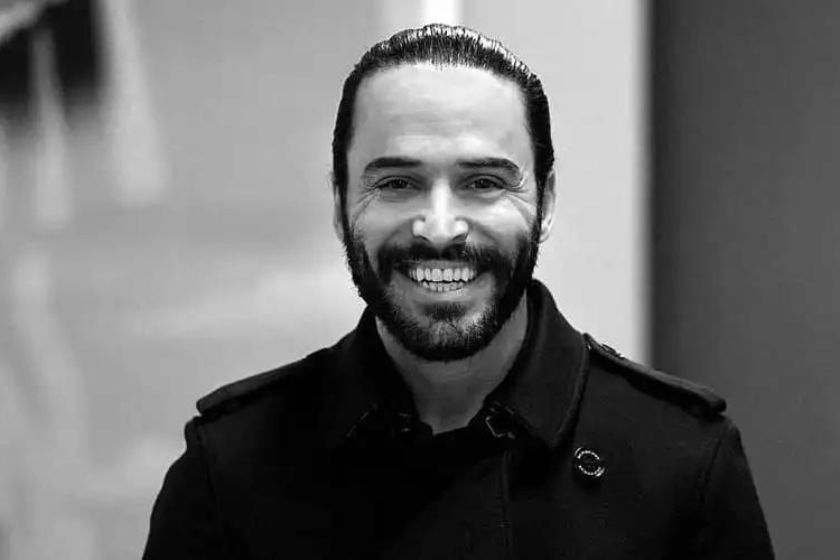
Assaâd Bouab is back on screen in the historical series, Franklin, currently airing on Apple TV+. He portrays the illustrious Beaumarchais, a faithful ally of Benjamin Franklin, in persuading the Kingdom of France to aid the Americans in obtaining their independence. Shoelifer sat down with the Franco-Moroccan actor, who is ultra-discreet but already involved in numerous new projects.
Franklin is blowing up at the moment. . Airing on the streaming platform Apple TV+ since April 12th, this 8-episode miniseries, part historical epic and part biopic, delves into the life of Benjamin Franklin, a founding father of the United States. It specifically focuses on his eight years (1770-1778) of efforts with the Kingdom of France to secure the support of King Louis XVI in the American War of Independence. It was a last-ditch mission, as at the time the American Revolution seemed doomed to fail simply because the rebels lacked weapons, ammunition, and money compared to the English.
In addition to credible reconstruction and ultra-polished imagery, the series boasts a stellar cast, including the iconic Michael Douglas (portraying Franklin), along with Ludivine Sagnier, Jeanne Balibar, Thibault de Montalembert, and Assaâd Bouab. The Franco-Moroccan actor plays Beaumarchais, the famous author of The Marriage of Figaro. Less known is the fact that the French writer and playwright was a true intermediary between his friend Franklin and the Count of Vergennes, a powerful French minister of Foreign Affairs under Louis XVI. Naturally, the editorial team couldn’t resist the urge to interview one of our favorite actors.
The series Franklin has been airing on Apple TV+ for about two weeks now and has received positive reviews in the press, notably from Télérama, but slightly less so from Libération. What feedback have you received?
Honestly, I don’t read the press too much. However, I did come across a fairly positive review from the newspaper L’Équipe, although obviously, you can’t please everyone. Friends and acquaintances who have seen the series are happy; maybe it’s just because they appreciate me (laughs)? I believe they are generally quite sincere. However, they did not recognize me physically (laughs).
Speaking of which, you wear the wig and the porcelain-like complexion of Louis XVI very well, which is not something everyone can do. How many hours of work per day did this physical transformation require?
I must say that the HMC (Hair, Makeup, Costume) team mobilized for the Franklin series is incredible. The transformation process is the first step when arriving on set in the morning. We arrive in sweatpants, hoodies, barely awake, and then we pass through magical hands that transform us. Overall, it takes about 1 hour/1 hour and 15 minutes of work between makeup, the wig, and costumes. By the way, the costumes, designed by Olivier Bériot, are marvelous.
I remember a scene, filmed at the Opéra Comique in Paris, where my character (Beaumarchais) goes on stage to announce the evening’s show, and there I found myself facing 200 extras in costume and wigs. It was impressive –I was almost transported to another era.
Read also : RESTFUL SLEEP: 5 TIPS FOR BETTER SLEEP
How did the role of Beaumarchais come to you? As a man of the theater, were you already familiar with this playwright?
I crossed paths with Beaumarchais thanks to a casting call for the series, Franklin, plain and simple. There were auditions in France and in the United States, and I was fortunate enough to hear about it through my agent and ultimately go through the process. I was somewhat familiar with Beaumarchais because of my theater school background and thanks to the eponymous avenue in Paris (laughs), but not much more than that.
But when you read Beaumarchais, you realize his irreverence and the incredible man he was. His father was a clockmaker, and he was the only boy among five sisters. Then he became a musician and inventor. In fact, he went to court several times because his patents were constantly being stolen. Eventually, King Louis XV heard about him and summoned him to his palace, where he was hired to be a music teacher to the king’s daughters. In addition to being a playwright, he also became a spy for the French Crown, then a shipowner and arms dealer to support American independence, even to the point of going into debt. In the series, he serves as a link and mediator between Franklin, the Count de Vergennes, and the king.
Obviously, there was probably a commercial interest, but he was a true defender of freedom, unafraid and bold. He printed Voltaire’s complete works in Germany, even though they were censored, and he invented the copyright system that we still benefit from today. Honestly, he’s a fascinating and intriguing character who deserves a series of his own. He’s also complex. Beaumarchais married a wealthy widow who died a year later. Her name was du Bosc Marchais, and that’s how he became Beaumarchais. In school, I didn’t retain much from my history lessons, but now it fascinates me!
Many viewers who have watched Franklin draw parallels between that period of history and today: the war in Ukraine, the dangers threatening American democracy… What parallels do you draw?
While preparing for Franklin, I read Beaumarchais’s works and Stacy Schiff’s book, The Great Improvisation, which inspired the screenplay. These events took place 250 years ago, yet in the grand scale of history, it’s almost as if it were yesterday. And they resonate with the present day: there are still powerful, sometimes unjust, armies dominating the world.
Franklin also comes out during an election year in the United States, so it’s probably important to revisit the history of their independence and the birth of their democracy. In fact, it’s up to people to form their own opinion about what resonates with the times. But I believe what we ultimately need to defend is the fight for freedom
How was it to act alongside Michael Douglas, who portrays Franklin? Not too stressful?
He’s a legend, just like his father, Kirk Douglas. When I was in middle school, I used to go around the corner to buy VHS tapes and watch their movies. When I was told I got the role, I was very moved, like, “Oh my God, I’m going to act with Michael Douglas!” (laughs). He’s a very generous, gentle man, who has nothing left to prove. He always has a twinkle in his eye, a mischievous spirit, and a little joke on his lips.
Your film career is rich and quite sharp. All the series you’ve appeared in (Braquo, Kaboul Kitchen, Messiah, Call My Agent, etc.) are successful, yet you’re an extremely discreet actor. How does that happen?
I don’t go out much, perhaps wrongly so; maybe I could go out more. Of course, I enjoy evenings out, but I’m quite a homebody. I also love theater, and I suppose that feeds into a certain discretion. Theater is hours of work in the dark, followed by a series of performances in the same place for several weeks.
But I’m very happy with the path I’ve taken, and I consider myself very lucky. Now it’s no secret; I really want to make the sequel to Marock. What perspective can we have on Moroccan society twenty years later? What does my generation want to talk about?
Oh, is Marock 2 in the works?
No, it’s not in the works; it’s just in my dreams. I’ve talked about it a bit with Laïla Marrakchi (the director of the film). She found it interesting, but I don’t know if it’s what she wants to pursue now. For me, it’s the film that kick-started my career. It’s the first time I was trusted. Just talking about it makes me emotional; I owe a lot to Marock.
Back to reality! After the Franklin series, airing one episode per week on Apple TV+ from April 12 to May 17, do you have any other projects?
Yes. I’ve written a short film, set in Morocco, which will be shot on location. I prefer not to say too much about it because we’ve just submitted the authorization requests to the Moroccan Cinematographic Center. But I can tell you that my brother, Younès Bouab, and actress, Nadia Kounda, will be in the cast.
A while ago, I also had dinner with Kirk Ellis, one of the writers of Franklin, and a history enthusiast. He asked me which historical character I’d like to play, and I said Ibn Battuta, to which he replied, “Ah, the great traveler!” Since then, we’ve found a production company in France and another in England, and we’re currently approaching streaming platforms to secure funding and start writing. It would be a rather epic series, based on the twenty-five years when Ibn Battuta traveled around the world without ever returning to Morocco.