

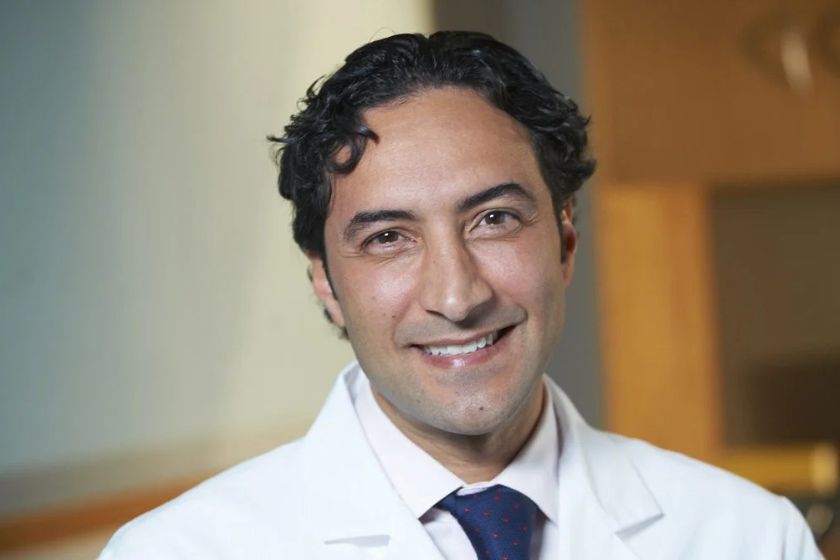
From the medical school of Casablanca to the operating rooms of Manhattan, Professor Karim Touijer has turned urology into the art of living well. A pioneering researcher, teacher, and humanist, his approach to medicine is more preventive, more equitable, and always deeply human.
7:15 a.m. in New York City. In the soft morning light, a car slips through skyscrapers and traffic. Inside sits Professor Karim Touijer, urologic oncologist and professor at Cornell University, speaking with surprising calm. He’s on his way to the Memorial Sloan Kettering Cancer Center, the world’s gold standard in oncology. His schedule is meticulously choreographed—surgery, meetings, research, teaching—but his voice remains relaxed, even warm. It’s clear we’re speaking to a man for whom excellence doesn’t preclude humility or kindness. He is a Moroccan thriving abroad, and quite literally changing the world.
The best doctor in NYC
Before making his mark in New York, Karim Touijer had already carved out an exemplary path. Born and educated in Casablanca, he graduated from the Faculty of Medicine in 1992. He went on to complete residencies in family medicine, general surgery, and urology at the University of Kansas Medical Center, then at the University of Arkansas for Medical Sciences. In 2002, he joined the Memorial Sloan Kettering Cancer Center, where he still works today as a specialist in urological cancers.
In parallel with his clinical work, he pursued a Master’s in Public Health at the Harvard T.H. Chan School of Public Health (2013–2015), one of the most respected medical institutions in the world, before joining Weill Cornell Medical College as a professor.
A Fellow of the American College of Surgeons and member of the European Academy of Urology—an elite group of just 75 top specialists worldwide—Touijer has authored over 200 scientific papers and 19 book chapters. In 2018, he was named one of New York’s Best Doctors by the Castle Connolly Top Doctors ranking, based on peer recommendations. He also appears in Marquis Who’s Who in America, which lists leading figures in medicine and research.
From Casablanca to New York: the journey of a real-lifesurgeon
Karim Touijer belongs to a generation of Moroccan doctors trained with old-school discipline: rigor, endurance, and resourcefulness. “It was the pre-internet era. For my thesis on multiple organ failure, I had to fly to Paris to access the medical school library. I came back to Morocco with kilos of photocopies. Ninety-nine percent of the papers were in English, so I translated them word for word. It took me a month! That’s when I thought—why not go straight to the source?”
The turning point came from a small article he’d once cut out of a youth newspaper, L’Opinion des jeunes, titled ‘Studying Medicine in the United States’ — just a mere address and two short paragraphs tucked inside a book. That little piece of paper would change his life. He headed for America. Residencies, internships, publications—he climbed each rung without a deliberate plan.
Then he discovered the Memorial Sloan Kettering Cancer Center—“the Mecca” of oncology. He wrote directly to the chairman, “randomly,” as he recalls. “I was fascinated by a surgical technique that didn’t yet exist but was going to shape the future of urology: minimally invasive surgery.” The response came quickly. “It was a Tuesday; I was invited to meet on Thursday.” The meeting went well: he was offered a place to train in urologic oncology and help develop the field of minimally invasive cancer surgery. Two years later, just as he was about to join another university, MSK offered him a position. “That was an offer I simply couldn’t refuse—joining the Memorial’s team is a once-in-a-lifetime opportunity.”
Now a New Yorker for over twenty years, Karim Touijer has built his family life there. A father of two, he rarely talks about his personal life, but you can sense in his voice the same gentle discipline he applies to his work—a quiet desire to pass things on, both to his children and to his young doctors. His son, Ryan Mekki, studies molecular biology and is drawn to medical research. His daughter, Zahra Grace, studies economics and international relations.
Urology, the science of precision
“Urology isn’t just men’s gynecology,” he jokes. “It’s a fascinating surgical specialty that concerns both women and men.” It covers the kidneys, bladder, prostate, testicles, urinary incontinence, and male infertility. “It’s a complete discipline—both treatment and prevention.”
In 2024, he published a randomized clinical trial on 1,500 prostate cancer patients—a first at that level of scientific rigor. “For decades, surgeons removed the prostate and lymph nodes without clear evidence that it improved survival. We wanted to prove it scientifically, with a fully randomized protocol to eliminate bias. The results showed that a complete removal—prostate and lymph nodes—both reduced the risk of metastasis and significantly improved survival. It’s a major step forward for the field.”
But his signature project is one he began back in 2006: developing a fluorescent molecule that makes cancer cells “light up” during surgery. “We attached a nanoparticle to a protein specific to prostate cancer. When injected into the patient, it binds to the cancer cells. With an infrared camera, we can spot them—even those hidden beneath tissue.” He smiles: “It’s the surgeon’s GPS.” The technology, now in clinical trials, could revolutionize cancer surgery and open a new chapter in urology.
Science, conscience, and public health
Touijer remains deeply attached to Morocco, his home and anchor. He’s quick to acknowledge the country’s medical progress. “Moroccan doctors have nothing to be ashamed of. They’re excellent, well trained. I can see the progress—the integration of robotic surgery, the growth of the private sector, the level of commitment…”
He now defines himself as both Moroccan and a citizen of the world. “I’m Moroccan—that’s my foundation, my instinct. But I also feel American, culturally francophone, and a bit Spanish, thanks to lifelong friendships. Identity is complex. We construct it t through relationships, travels, and influences. But our values—they stay the same.”
When asked about the GenZ212 movement—young Moroccans calling for fairer public healthcare—he shares an anecdote that stuck with him. “At Harvard, during my public health master’s, a professor asked: ‘Is health a right or a privilege?’ The Americans said, ‘a privilege.’ The Europeans said, ‘a right.’ The truth depends on a country’s political and economic context. But one thing is certain: investing in health and education is vital. It pays off in the long run.”
Prevention is the best cure
For Touijer, urology doesn’t end in the operating room. It’s also about dialogue, education, and connection. “The best treatment is prevention,” he says, calm but firm—as if stating an obvious truth.
He advocates HPV vaccination “for girls, but also for boys—because it’s an act of collective responsibility.” He stresses the importance of screening. From age 45, a simple prostate blood test can save lives. At 50, colonoscopies and colorectal screening become essential. For women, mammograms and regular Pap smears remain simple, vital weapons. “We don’t cure cancer by magic. We stop it from taking root.”
On smoking, he doesn’t hold back: “Tobacco isn’t a habit—it’s a disease. What infuriates me is that some cigarettes sold in Africa contain far more nicotine and harmful chemicals than those sold elsewhere. That’s pure industrial cynicism.” Urology sees the consequences first-hand: bladder and kidney cancers, chronic damage, preventable suffering. “Tobacco is poison, sold with a smile.”
Read also : LAMIAA DAÏF: FROM CASABLANCA TO SILICON VALLEY, THE MOROCCAN WOMAN REDEFINING FEMALE LEADERSHIP
Medicine as the art of living well
Though he stands at the forefront of urological science, Touijer never loses sight of its human dimension. “Medicine is a science, but it’s also an art. The human side—that’s the art.” He speaks of empathy, psychology,and simply listening. “A vulnerable patient has the right to be anxious. Our role is to stand beside them. Humanity itself has a placebo effect.”
He likens healing to a marathon: “The mind matters as much as the technique. A patient who keeps hope fights better.” At Memorial Sloan Kettering, he ensures spirituality has its place too—priests, rabbis, imams regularly visit patients. “The body is a machine, but the mind is the compass.”
Reserved about his private life, he rarely talks about anything beyond his work. Yet in the way he listens and chooses his words, you sense a man both grounded and deeply curious about the world. “Science keeps us humble. The more we learn, the more we realize what we don’t know. It’s methodical, rigorous, sometimes seen as cold—but it carries the same subtle intelligence as a flower: a perfect mechanism designed to attract pollinators, while offering beauty that moves us. That’s medicine—the meeting of scientific precision and human compassion. ”
And when asked whether he still believes in that quintessentially American dream of “eradicating cancer,” he exhales softly. “It’s a beautiful utopia. Cancer is part of life. What we can do is understand it, prevent it, catch it early. We can gain time—and quality of life. And that’s already a lot.”