


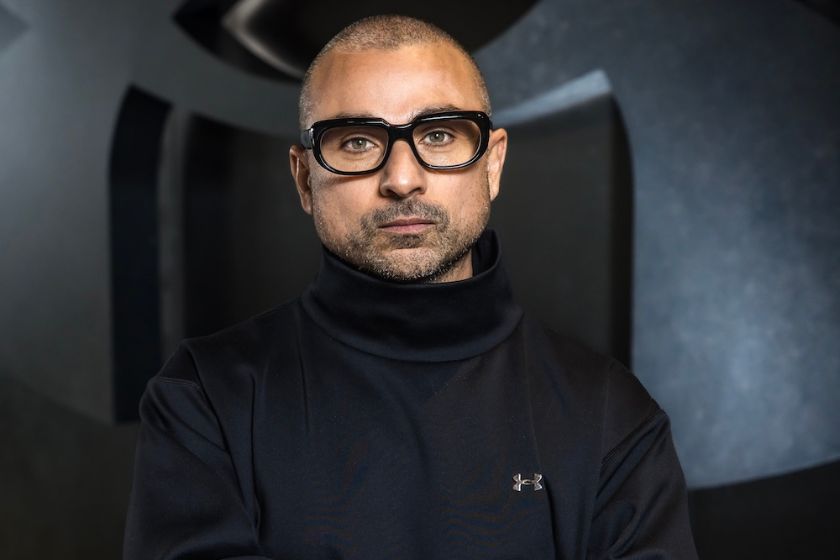
A veteran of the sportswear industry, Yassine Saïdi worked his way through some of the biggest names in athletic apparel before joining Under Armour, where he has just launched the UA x Achraf Hakimi x Hassan Hajjaj collaboration. It’s a success story built without shortcuts, spanning Lille, Morocco, and the world’s sporting capitals—shaped by a proud Moroccan identity and a career forged on the international stage.
In early 2024, Yassine Saïdi joined Under Armour as Product Director. It was an appointment that wasn’t a coincidence but a culmination. . Born in Lille in 1979, raised in a working-class family by Moroccan parents from Tangier—a gardener father and a cleaner mother—he grew up with one simple, non-negotiable rule: no time to waste. “My parents understood very early on that time was the ultimate currency.”
“Showing that everything is possible”
It was tennis instead of football, and private lessons in Arabic, mathematics, science, and English to fill his free time and keep him from hanging around the streets. Through their work for executives and large industrial families, his parents observed how elites were shaped—and decided to pass those values on to their children. Every summer spent in Morocco—two full months living among people, learning the language, the dialect, the culture—cemented a lived, never theoretical, sense of Moroccan identity.
“When people ask me where I’m from, I always say I’m Moroccan, but that I grew up in France.” At the time, children of immigrant backgrounds were mostly expected to fit in. He quickly understood that progress doesn’t come from conformity, but from embracing a different path. Over time, that singularity became a form of responsibility. “Representing your country, its youth, showing that everything is possible—especially when you come from a modest background.” It was a responsibility amplified by hyper-visibility, by the gaze of others, by an unspoken expectation to lead by example. Under Armour thus appears as the natural continuation of a journey shaped by discipline, adaptability, and bold choices.
From board sports to global strategy
It was board sports that guided Yassine Saïdi’s early career-defining decisions. After a first year at Lille business school, he hesitated between Grenoble and Annecy—where skis, snowboards, surfboards, and technical gear were conceived. He chose Annecy and enrolled at Université Savoie Mont Blanc for a master’s degree in business management, with one clear goal in mind: securing an internship at Salomon, then the undisputed benchmark in outdoor and board sports equipment.
At the time, only one internship was available. Thirty candidates applied, most of them born in the Alps, skis on their feet since childhood. He arrived from Lille—flat land—with a twenty-page application and a clear brand vision. He got the internship, and with it, a revelation. “I wasn’t the most obvious candidate on paper, so I had to be the most precise in my vision.”
The sports industry became his playing field. He joined Adidas for two pivotal years, at a time when the brand was carried by its football icons, including Zinedine Zidane. But he didn’t enter through football. Staying true to a childhood choice—the little yellow ball over the big white and black onel—he joined the tennis division and became head of the French market, with Roland-Garros as his main stage.
“When I was younger, I used to revise for my exams while watching Roland-Garros on TV. Suddenly, I was watching matches from the equipment sponsor’s box.” His trajectory accelerated. Yassine Saïdi was then appointed International Tennis Director in Germany, working directly with icons such as Agassi and Djokovic. “It was a new life, a whole new level,” he admits.
Then came a defining decision: turning down Nike to join Puma, which was struggling at the time. “At Nike, I would have done what I already knew how to do. At Puma, everything still had to be built.” There, he created Lab Puma, injected fashion, music, and culture into performance, initiated major collaborations with Rihanna, The Weeknd, and Selena Gomez, and supported spectacular growth—from $2 to $8 billion in revenue over nine years. One lesson stood out: the brands that truly leave a mark are those willing to step outside their own comfort zone.
Under Armour and the “Moroccan Gang”
When Yassine Saïdi joined Under Armour, the brand was in the midst of a turnaround. His mission was clear: rebuild the product strategy and tell new stories. “I chose Under Armour for its potential.” Very quickly, he introduced a broader interpretation of sportswear, where the product becomes narrative. He was behind the signing of Achraf Hakimi—previously under contract with Adidas—and turned that move into a cornerstone of the brand’s repositioning. Jerseys, cleats, references to sfifa, deliberate nods to Morocco’s ancestral artisanal savoir-faire, even though the Moroccan national team remains officially equipped by Puma.
Hakimi himself is individually equipped by Under Armour and wears the brand’s cleats, including in international competition. With photographer, creator, and designer Hassan Hajjaj shaping the visual identity, everything came before words. When Shoelifer refers to a “Moroccan gang,” Saïdi smiles—he never thought of it that way, but the expression feels right. No strategy, no calculation. “We met through connections, through mektoub. Everything happened organically.”
https://www.instagram.com/reels/DH-zkE0OTJ9/
It’s a story of three paths, three different backgrounds, one shared story of European immigration and deeply rooted Moroccan identity. They don’t compete with each other, but complement each other. The product becomes a vehicle for transmission, a tribute to the caftan, the gandoura, and Moroccan heritage—where so many collaborations lack any real origin story. At Under Armour, performance alone is no longer enough; it has to mean something.
Moroccan soft power, AFCON, and the road to 2030 at Under Armour
When Shoelifer speaks with Yassine Saïdi via video call, he is in the United States, about to announce his new role as Senior Advisor for Design and Creative Continuity at Under Armour. He is also preparing to relocate to Marrakech, to operate directly from the Kingdom. During the interview, his phone buzzes—messages from Achraf Hakimi. That very evening, the Atlas Lions are set to play an AFCON semi-final against Nigeria. The closeness between the two men is not declared; it is lived.
This relationship is rooted in a broader, deeply Moroccan culture, where transmission begins with mothers. Yassine Saïdi often recalls a powerful moment from the 2022 World Cup, when the players were received in Rabat alongside their mothers. This symbol left a lasting impression on him. “Mothers play a central role in our journeys, in our discipline, in our values.” He says it plainly: if he were ever to be received by the King, he would come with his own mother. “Soft power always starts with sport—then come lifestyle, fashion, culture.” As the 2030 World Cup approaches, he sees Morocco as a vast territory of expression, still loosely structured but rapidly accelerating.
He advocates for a facilitating state—one that supports without restricting—and closely observes the Emirati and Saudi models, where Under Armour already has a presence. Within the brand, this vision translates into a clear ambition: to support the structuring of national sport and align with major upcoming milestones. But his outlook extends beyond a single brand. For Yassine Saïdi, Under Armour is a lever, a field of expression at a specific moment in his trajectory—not a final destination.
Fearless, starting from nothing, he embodies a form of success driven by education, audacity, and choices often made against the current. What comes next remains open. Time will tell where—and how—Yassine Saïdi chooses to extend this journey, in the service of a brand, a personal project, or a vision still taking shape.