

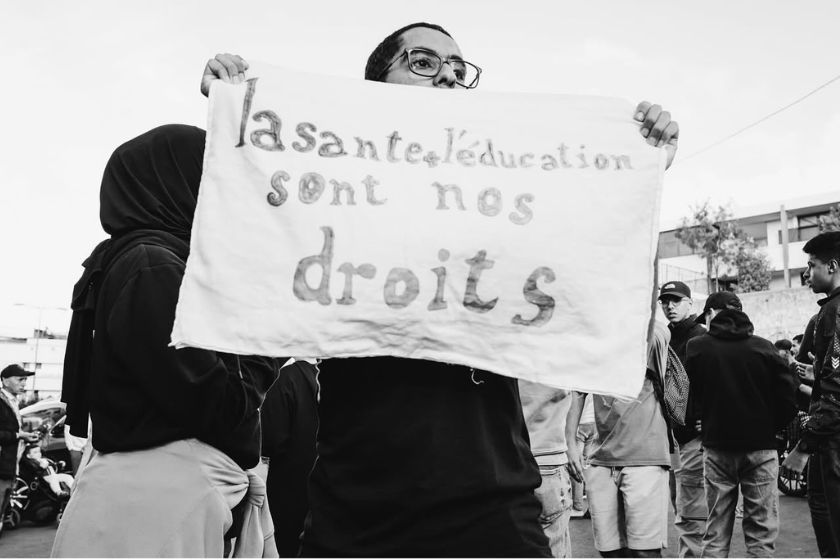
Since September 28, GenZ 212 has been taking to the streets in Morocco, echoing a global phenomenon. Their expectations? Their MO? Their sometimes bewildering humor? Shoelifer provides a snapshot—as incomplete as it may be—of this youth that continues to defy our expectations.
Since September 28, Moroccan streets have been filled daily with young people who first organize online before meeting in person. Behind the movement, one collective has emerged: GenZ 212, the local manifestation of a generation in flux worldwide, now counting nearly 175,000 members on Discord. The phenomenon resonates far beyond Morocco—from Nepal to Madagascar, Peru to the Philippines—but here it takes on a unique flavor. Their MO, however, is familiar: horizontal organization, biting humor, and creativity amplified by digital tools. The message? Out with the old world, in with a generation that refuses to be passive—with energy, flashes of brilliance, and a streak of naivety. Our editorial team tries to make sense of it all.
Sketching the Gen Z profile: where they’re coming from
Born between 1997 and 2010, Gen Z has grown up online, where the Internet is its own ecosystem. Their instinct isn’t to “find a leader” but to open a server, launch an FAQ, set a time. Their language is visual and instant: short-form videos, subtitles, voiceovers, and punchlines designed to go viral. They distrust parties and unions, preferring fluid collectives where roles rotate.
What are their guiding principles? Dignity, equal opportunity, true meritocracy, transparency. They’re fearless, sometimes to the point of recklessness, but it’s this raw boldness that gives them media impact and influence over public opinion. In Morocco, they’ve added their own twist: constant code-switching (Darija, French, English) and an ability to craft a language that works everywhere, from the neighborhood to the global TikTok.
What ignited the blaze? Shared desperation and daily realities
Three main grievances are universal: jobs and purchasing power (degree ≠ employment), corruption (lack of meritocracy ), and generational injustice (the previous generation pulled the ladder up from behind them)s). In Morocco, the blaze is fueled by specific, urgent factors: healthcare, education, and the demand for decent public services.
While some write off their arguments as seeming entitled and merely a generational whim,how can one speak of patience when inflation erodes purchasing power, the future seems blocked, and the planet overheats? For Gen Z, impatience is not merely a cultural trait—it’s a survival reflex.
Organization: “be water,” Maghreb-style
The mantra comes from Hong Kong protests in 2019: be water—fluid, elusive, appear, disappear, repeat. In Morocco, it manifests through Discord/Telegram for logistics, TikTok/Instagram for impact. Horizontal doesn’t mean chaotic; it’s modular: rotating roles, temporary accounts, shared documents. They test, adjust, and relaunch like a startup refining its product. Thanks to the dual channels of WhatsApp/Stories, a single visual can traverse the country in an afternoon. The risk? Losing coherence and sending mixed signals.
Language, creativity, and humor: when pop culture becomes politics
Gen Z communicates in sharable references: One Piece pirate flags, Hunger Games salutes, Pepe memes repurposed—global symbols adopted because they’re instantly readable and easily replicated.
In Morocco, these icons blend with local flair: Darija, inside jokes, familiar sounds. The result is a hybrid language that breaks through political jargon and even rallies non-activists. Above all, this generation is a communication prodigy. It wields memes like others wield editorial power. In two hours, a video montage can rival a column. Memes democratize, lighten the mood, and accelerate messages. In the Kingdom, this skill is evident: instant remixes, reworked audio, fake tutorials, carefully timed subtitles. The joke, “last in public school, first in memes”, seems relevant here… andumor is one of their strategies.
Read also : LAMIAA DAÏF: FROM CASABLANCA TO SILICON VALLEY, THE MOROCCAN WOMAN REDEFINING FEMALE LEADERSHIP
What Gen Z wants (beyond the slogans)
Their demands are clear: decent healthcare and education, an end to nepotism,, institutions that provide more than lip service , measurable results, and a real seat at the table. Gen Z doesn’t dream of “later”; it insists on now. Another key trait: an intersectional approach.
Climate, gender equality, social justice, diversity, individual freedoms—the struggles mix rather than rank hierarchically. But once the foundation is set, the horizon blurs: how to finance it, who governs, and how to organize? The grievences are clear, but how to move forward less so. This is both the strength and limitation of this generation: a clear, immediate energy, but a long-term vision still in development.
The clash: real-time vs. long-term
The real divide isn’t ideological—it’s temporal. What they call “the old world” thinks long-term: procedures, caution, stages. Gen Z operates in real-time: horizontal, clear, tangible. The former says, “wait,” the latter hears, “you’re stalling us.” Both sides have some truth to them: long-term thinking avoids structural errors; real-time action prevents stagnation.